
 By Tommy Lee

Why a hobby is not a waste of time. It is how your mind gets its rest.
Recently I was reading a story about former Pittsburgh Steelers coach Mike Tomlin, who is now with NBC. He coached the Steelers for 19 seasons, won a Super Bowl, and is one of the most respected leaders in all of sports. And for the last twelve years, in his spare time, he has been quietly building a huge, detailed city in the video game Minecraft. At the end of September of this year he finally showed it off in a video on YouTube, and it got more than a million views in about a day. A million people watched a football coach give a tour of a city he built block by block.
He said it started when his kids were young and he watched them play. It became a way to stay close to them, and he said it “allowed me to detach from the realities and the pressures of life.” He called it therapeutic. This was so fun to read. Coach Tomlin had one of the most pressure filled jobs in the country, and his release was building a pretend city for over a decade. (One piece of advice someone gave me as a parent: find something your kids enjoy doing and do it with them.)
I love this, because I really believe we should all have something like this. Hobbies are not a waste of time. They take your mind off work, and they help you relax and regroup. I know that sounds obvious, but a lot of driven people treat a hobby like a guilty pleasure, something they will get to when the work is done. But the work is never done. So they never rest, and it wears on them.
First, last year Harvard Business Review published research by Leslie Perlow and two colleagues. They studied 1,500 Harvard Business School alumni with full time careers and families. After work, family duties, and sleep, these people had about 26 free hours a week, and how they spent those hours mattered more than how many they had. When they were on their own, active things like exercise, hobbies, and volunteering scored 2.4 out of 3 for joy. Passive things like TV and scrolling scored 1.7. And it carried over into work. The people with more joyful free time found more purpose and success in their jobs.
Second, your mind needs to leave work, not just your body. Researchers call this psychological detachment. It means actually getting your head off work, not closing the laptop and then stewing about it all night. People who can do this are less worn out and more satisfied with life. HBR ran a piece in 2024 on a study that followed 73 leaders for 10 days. On the nights they switched off from work, they felt more recharged the next day, and their own employees rated them as better leaders that day. On the nights they kept stewing about work, they woke up drained. It hit new managers the hardest.
Third, the best hobbies take a little effort. Researchers list learning and challenge as one of the main ways people recover from work. They call it mastery. Another HBR piece from 2025 calls it “leisure crafting.” It means taking something you already enjoy and giving it a goal, a skill to grow in, or people to do it with. The researchers ran 11 studies with more than 2,400 working professionals. People who did this had more energy, better moods, and said they were more engaged and creative at work. In one test, 257 people were split into two groups for a month, and the group that learned to do this grew in well being 1.6 times more than the group that didn’t. What I liked is that they said it is not about which hobby you pick. It is about how you do it. Even gaming counts if you go at it with a goal. That is what Tomlin was doing. He had a goal, he got better at it every year, and he did it with his kids. For me I love fantasy sports and I love tinkering and learning things in AI.
And it shows up at work. A 2014 study out of San Francisco State, led by Kevin Eschleman, found that people who did creative hobbies fairly often scored 15 to 30 percent higher on performance ratings than people who only did them once in a while. They were also more likely to come up with creative solutions at work and to help their coworkers. Fast Company has written about this study, along with another one that followed 40 scientists over 20 years. The most successful ones, including four Nobel Prize winners, were more likely to have hobbies like art and music. To be fair, these studies show a connection. They do not prove the hobby caused it.
A 2018 Harvard Business Review article looked at S&P 500 CEOs and found 56 of them with serious hobbies, most going back to college or earlier. When David Solomon became CEO of Goldman Sachs, the news covered his side gig as a DJ. The CEO of Electronic Arts does Brazilian jiu jitsu and said that when someone is trying to take your head off, that is all you can think about. Many of these CEOs block off time for their hobby far in advance so life doesn’t crowd it out. One of them put it simply: “It will force you to find time for it.”
I would add one more thing. Rest is built into us. God himself rested on the seventh day (Genesis 2), and he told us to rest too (Exodus 20). We are not machines, and we were never meant to run flat out without a break. A hobby is one way to take that seriously.
Here are a few simple ways to start.
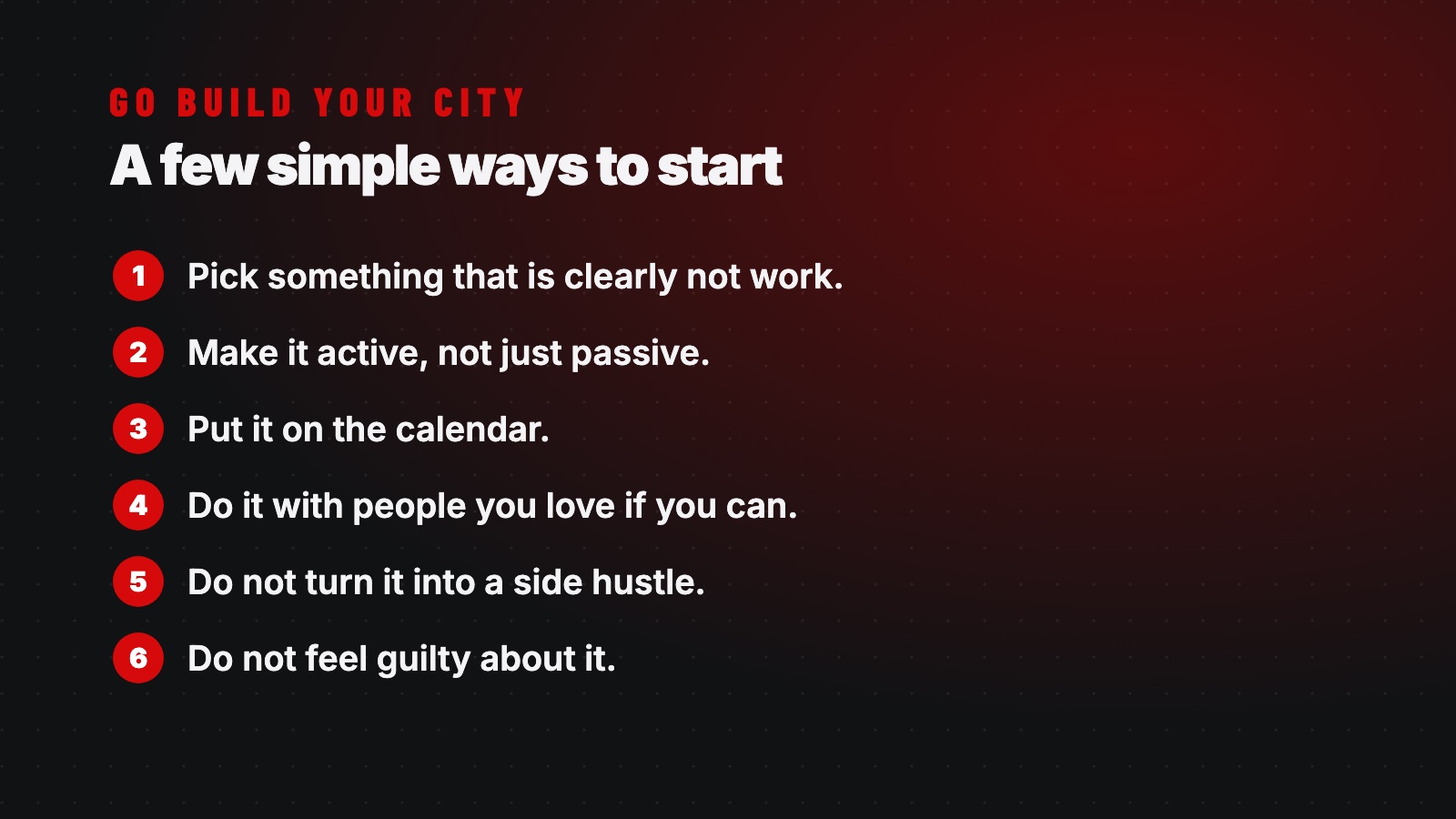
- Pick something that is clearly not work. Building, music, cooking, a sport, a garden, fishing, even a video game. It does not have to be productive. That is the point. I would recommend it be different than what you do at work.
- Make it active, not just passive. Scrolling your phone is not really a hobby, and it does not refresh you the same way. Do something that takes a little effort and skill. Time flies or you get into a zone when you do this.
- Put it on the calendar. If you are a busy person, it will not happen by accident. Protect the time the way you protect a meeting.
- Do it with people you love if you can. Mike Tomlin built his city with his kids.
- Do not turn it into a side hustle. Fast Company had a piece on this. The typical side hustle pays about $200 a month for 11 to 16 extra hours a week. Once it is about making money, it is just more work. Tomlin is not selling his city.
- Do not feel guilty about it. Kelsey Alpaio wrote in HBR that “it’s OK for a hobby to just be that.” I agree.
For me, rest has always mattered. I plan my days tightly, I take my 20 minute nap every day, and I build in real breaks with my fantasy sports and AI building, because I know I cannot pour out if I never refill. A hobby is the same thing.
Mike Tomlin did not apologize for his city. Go build your city.
Articles you may be interested in
- Leslie A. Perlow, Sari Mentser, and Salvatore J. Affinito, “How the Busiest People Find Joy,” Harvard Business Review, July 2025.
- Remy E. Jennings, Allison S. Gabriel, and Klodiana Lanaj, “Want to Be a Better Leader? Stop Thinking About Work After Hours,” Harvard Business Review, January 2024.
- Alexander B. Hamrick and colleagues, “Research: How ‘Leisure Crafting’ Can Help You Recharge,” Harvard Business Review, April 2025.
- Emilia Bunea, Svetlana N. Khapova, and Evgenia I. Lysova, “Why CEOs Devote So Much Time to Their Hobbies,” Harvard Business Review, October 2018.
- Kelsey Alpaio, “Can Hobbies Actually Make You a Better Person?” Harvard Business Review, October 2021.
- Aytekin Tank, “How hobbies can improve your happiness and productivity at work,” Fast Company, August 2019.
- ESPN, “Former Steelers coach Mike Tomlin’s Minecraft city,” September 30, 2026.