
 By Tommy Lee

Most leadership advice is about how to lead the people under you. But almost all of us have someone above us too. A boss, a board, a senior pastor, a donor, a client. How well you work with that person has a lot to do with how much you can get done. Gallup has found that managers account for about 70% of the difference in how engaged their teams are.
That is what people mean by managing up. I don’t mean flattering your boss or playing politics or sucking up to him or her. I mean making the relationship work so both of you can do your jobs well and get the job done.
I have people who report to me, and I also report to a board. So I have been on both sides of this. Here are a few things I have learned, mostly from watching the people who taught me well.
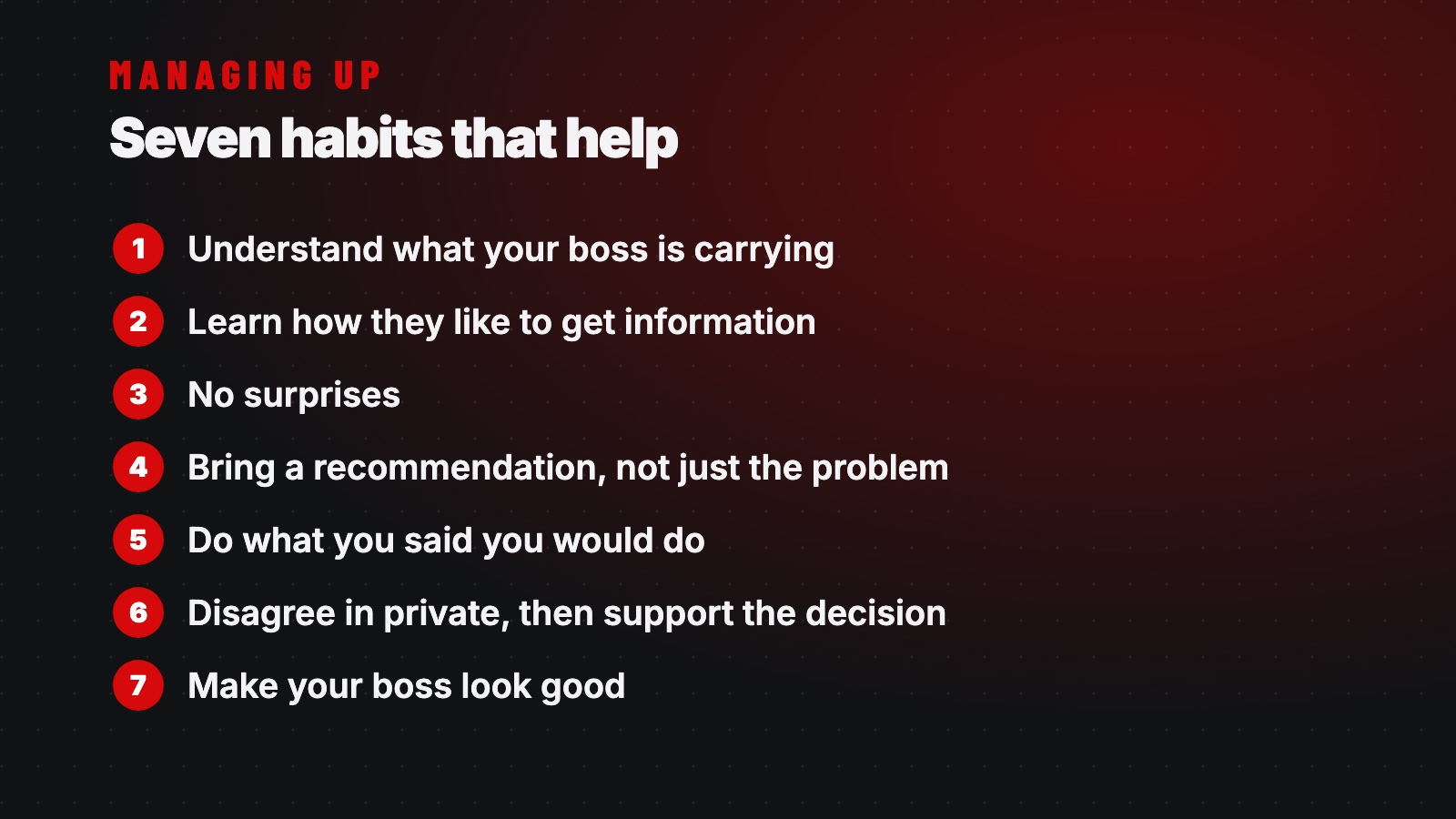
Understand what your boss is carrying
Your boss has pressures you don’t see. They have goals they are being measured on, people above them, and problems they haven’t told you about. You may not have the full picture of what is going on.
Back in 1980, John Gabarro and John Kotter wrote a classic article in Harvard Business Review called “Managing Your Boss.” Their main point was that you and your boss depend on each other. You need them, and they need you. So it is worth taking the time to understand what they are trying to accomplish, what they are worried about, and where they are strong and weak. Then do the same for yourself. Also, it’s very key to understand realistically what your boss’s strengths and weaknesses are and how to work to support those boundaries.
Learn how they like to get information
Some people want a quick text. Some want a one page summary they can read before a meeting. Some want to talk it through in person. Peter Drucker wrote about this in his Harvard Business Review article “Managing Oneself.” He said some people are “readers” and some are “listeners.” His examples were President Eisenhower, a reader, and President Lyndon Johnson, a listener. If your boss is a reader and you keep trying to explain things in the hallway, it won’t land. If they are a listener and you send a long email, they probably won’t read it.
If you are not sure, just ask. “How do you like to get updates from me?” That one question can save you a lot of frustration and make things clear. DO NOT assume. I hear a lot of “I thought.” Don’t assume. Just ask. “Hey, I want to make sure I get you what you need in a timely and organized way. How would you like the information?”
Michael Watkins, who wrote The First 90 Days, says you should have this conversation about working style with every new boss: how you will communicate and how often. Don’t wait six months to figure it out.
No surprises
Most bosses can handle bad news. What they don’t like is hearing it from someone else first, or finding out too late to do anything about it.
If something is going sideways, tell your boss early. Tell them what happened, what you are doing about it, and what you need from them. Don’t wait until you have it all fixed. Most bosses would rather hear about a small problem now than a big one later.
Mita Mallick wrote in Fast Company about learning this the hard way. Early in her career she was working on key projects, but she never kept her boss updated on what she was doing. When layoffs came, she was one of the first people let go. Her advice now is to keep your boss updated so they are never caught off guard.
Bring a recommendation, not just the problem
You don’t have to have every answer. But when you bring a problem, bring your best thinking too. “Here is the issue, here are two options, and here is what I would do.” That makes it much easier for your boss to say yes, and over time it builds trust. They start to see that you can think through these things and there is a reason for your action.
But don’t sit on a problem just because you haven’t solved it yet. Sabina Nawaz wrote in Harvard Business Review that the old rule, “Don’t bring me problems, bring me solutions,” can make people hide problems until it is too late. Bring your best thinking, but bring the problem early.
Do what you said you would do
This sounds so simple, but it matters more than almost anything else. Meet your deadlines. If you are going to miss one, say so before it passes, not after. When your boss can count on you, they stop checking on you, and you get more freedom. This is very key.
Disagree in private, then support the decision
Managing up doesn’t mean agreeing with everything. A good boss wants you to push back. But do it in private, do it respectfully, and come with reasons. And once the decision is made, get behind it. Don’t go back to your team and say, “Well, I didn’t agree with this.” That hurts everyone. I find myself saying this phrase: “I will always respect your leadership, but would you allow me to express to you privately some of my concerns or a different way of looking at things?”
Amazon calls this “disagree and commit.” One of its leadership principles says leaders are “obligated to respectfully challenge decisions when they disagree.” But once the decision is made, they commit to it fully. Jeff Bezos wrote in his 2016 shareholder letter about doing this himself on an Amazon Studios show he had doubts about.
Make your boss look good
Your job is to make your boss look good. I don’t mean lying for them or covering for something wrong. I mean doing your work so well that it makes them better at theirs.
When your boss walks into a meeting with their boss, are they ready because of you? Did you get them the numbers before they asked? Did you catch the mistake before it went out? When your team wins, give your boss credit in front of other people. When something goes wrong on your watch, own it.
Joseph did this. He was a slave in Potiphar’s house, and the Bible says “the Lord blessed the Egyptian’s house for Joseph’s sake” (Genesis 39:5). It got to the point where Potiphar didn’t worry about anything except what he was having for dinner (Genesis 39:6). Potiphar looked good because Joseph worked for him.
And when you make your boss look good, you usually become the person they want to bring with them.
Nehemiah managed up
A good example of this is Nehemiah. He was the cupbearer to King Artaxerxes, and he was heartbroken about the walls of Jerusalem. When the king noticed and asked him what he wanted, Nehemiah said, “So I prayed to the God of heaven. And I said to the king…” (Nehemiah 2:4 to 5). He had a quick prayer, and then he had a clear, specific ask ready. He asked for time off, for letters so he could travel safely, and for timber from the king’s forest. He had clearly thought it through before the moment came.
And Nehemiah says, “the king granted me what I asked, for the good hand of my God was upon me” (Nehemiah 2:8). He respected the king, and he came prepared, but he also knew who was really behind it.
Now, what if your boss is bad?
Bad bosses come in a lot of forms. They can be lazy. They micromanage. They change their mind every week. They are moody, they play favorites, or they yell. We all know what those guys look like because we have had to work for them in the past. You are not alone. In 2015 Gallup surveyed more than 7,000 American adults, and one in two said they had left a job at some point to get away from their manager.
First, ask what is driving it. A lot of bad bosses are insecure, or getting squeezed by the people above them. That doesn’t excuse it, but it helps you not take all of it personally.
Then have the honest conversation, in private. Be specific. Don’t say “you always.” Say something like, “When the plan changes the night before, the team has to redo the work. Can we lock things in by Wednesday?” A lot of bad bosses have no idea how they are coming across because nobody has ever told them.
Mary Abbajay wrote in Harvard Business Review not to try to fix your boss. Instead, ask for what you need to do your job well, build a support network, and look at other roles, even inside the same company.
Now if they know they are being jerks and don’t care, then forget about it. Do what you need to do to still be a good employee but be looking for other roles. You don’t need the headache, but you do need the salary until you find something.
Control what you can control. Your attitude, your work, and your words. Find a mentor or a friend outside of work you can talk to, so you aren’t carrying it alone and you aren’t venting to your team.
When is it time to leave?
Sometimes it may just be too hard. You’ve tried your best and it’s time to go.
Here are a few signs to know when it’s time to go:
- They ask you to do something unethical or illegal, or something that goes against your faith. That is a line. Don’t cross it to keep a job.
- There is abuse. Yelling, threats, harassment. Don’t stay and call that being faithful and attempt to press on. You don’t need to deal with that. Go to HR or someone above them, and if nothing changes, leave.
- It is hurting your health or your family. If you dread every Sunday night and you are bringing it home to your spouse and your kids, pay attention to that.
- You have had the honest conversation more than once, and nothing has changed.
- You think about your boss more than you think about your work. Abbajay says that if you dread work every day and think about your boss more than your job, “it may be time to go.”
Colossians 3:23 says, “Whatever you do, work heartily, as for the Lord and not for men.” We don’t manage up to get ahead or to make ourselves look good. We do it because doing our work well, and making the people around us better, is part of how we serve God. And because God already accepts us in Christ, our boss’s approval doesn’t have to be what we live for.