
 By Tommy Lee

Growing up, my parents always taught me to work hard, put my head down, and people will notice. And God will notice.
I still believe that. But I also learned it only works to a degree. If you aren’t going to share what you are doing, there will be others who see it and grab the credit.
At some point most of us need people to know what we are doing. Maybe it is for a promotion, a pay raise, or more opportunities. For me it has been Resource Global. We were a small organization and I don’t have a big social media following. I am not the senior pastor of a mega church. I had to learn how to share with donors and create awareness of what we were doing. But I didn’t want to brag. As an Asian, talking about myself has never come naturally.
Leslie John, a professor at Harvard Business School, wrote about this in Harvard Business Review. She grew up hearing something very close to what I heard. Her father always told her, “The cream will rise to the top.” She still believes that consistent work is the best way to earn recognition. But she also says “cream sometimes needs a little help to rise.” She points out that some cultures, like the United States, are more open to self promotion than others, but people everywhere are turned off by bragging.
So how do you share without bragging? Here are a few pointers.
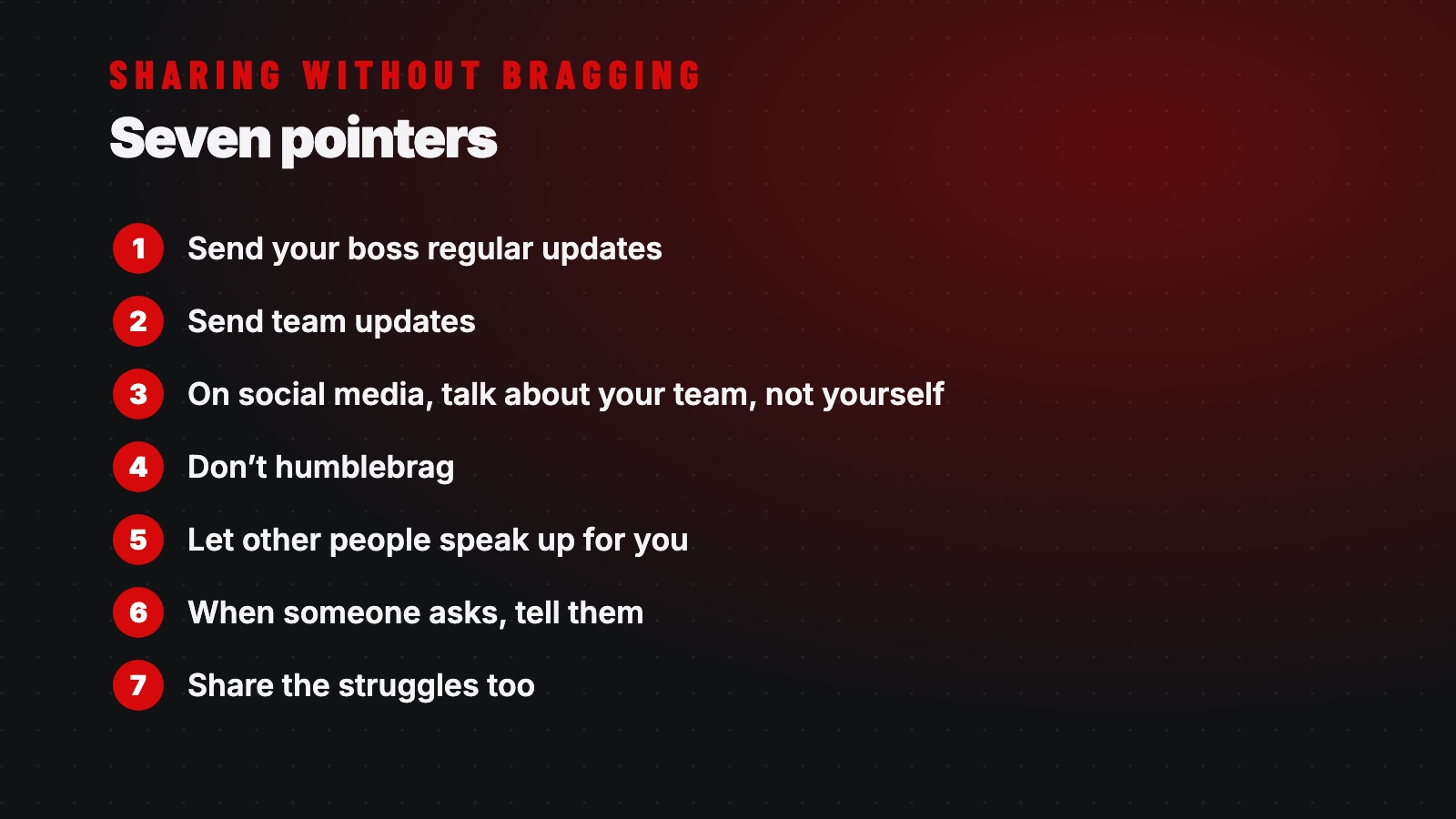
1. Send your boss regular updates
Whoever your boss is, send them regular updates on what you are doing. Don’t wait for your annual review. If they hear from you regularly, they already know what you have been working on, and you don’t have to make a big speech about it later. If you are a pastor or ministry leader, your board and your donors are your boss in a lot of ways. The same thing applies. I used to send my boss weekly email updates on the projects I was working on.
Paul and Barnabas did this. When they came back from their first missionary journey, they gathered the church that sent them out and “declared all that God had done with them” (Acts 14:27). They gave a full report, and the credit went to God.
2. Send team updates
Do the same thing with your team. Tell them what is going on, what is working, and what you are learning. It keeps everyone on the same page, and it shows the work belongs to all of you.
3. On social media, talk about your team, not yourself
Share updates about your team or your organization so people will know what is happening. But give the credit to the team and not yourself. No one likes someone bragging about themselves on social media.
There is research behind this too. Leslie John points to studies on “positive gossip,” which found that people are thought of more highly when they brag about others. So celebrate your people. Name them and thank them.
4. Don’t humblebrag
A humblebrag is when you dress up a brag to sound humble. It usually comes out one of two ways. Some sound humble, like “I can’t believe I got this award!” Others sound like a complaint, like “Ugh, three conferences this month. I am so tired.” In church circles it can sound like “So humbled to share…” or “God has really blessed my ministry this year.”
Ovul Sezer, then at Harvard, and her colleagues ran a series of studies on this. In one survey, 70% of people could remember a recent humblebrag. The complaint kind was the most common, about 60% of them. And it doesn’t work. People who humblebragged were liked less and seen as less competent than people who just stated the accomplishment plainly. The complaint kind did even worse than plain complaining.
Why? People see right through it. Sezer told TIME, “You think, as the humblebragger, that it’s the best of both worlds, but what we show is that sincerity is actually the key ingredient.”
It even hurts you in a job interview. In one of her studies, students were asked about their biggest weakness, and 77% of them humblebragged. The most common answer was “I’m a perfectionist.” The people reading the answers were much more interested in hiring the ones who gave an honest answer.
Jesus told a story about this. A Pharisee went to the temple and prayed, “God, I thank you that I am not like other men… I fast twice a week; I give tithes of all that I get” (Luke 18:11 to 12). It sounds like a prayer of thanks. It is really a brag. Jesus said it was the tax collector, who only asked for mercy, who went home right with God, “for everyone who exalts himself will be humbled, but the one who humbles himself will be exalted” (Luke 18:14).
So if you have good news, just say it plainly and thank the people who helped. Before you post, ask yourself: Am I trying to be honest, or am I trying to sound humble?

And let’s face it. If you are a Christian reading this, Christians are NOTORIOUS for humblebragging.
5. Let other people speak up for you
A series of studies led by Jeffrey Pfeffer at Stanford gave people a job interview transcript and asked them to set a salary. In one version the candidate said, “Anyone who has worked with me would say that I am a natural leader.” In the other version a recruiter said the same thing about her. The candidate who had someone else speak for her was better liked, seen as more competent, and given higher pay.
So ask a mentor, a board member, or a partner to share what they have seen. Most of us don’t like asking. But research led by Vanessa Bohns at Cornell found that we underestimate how willing people are to help us by about 50%.
This is not new. “Let another praise you, and not your own mouth; a stranger, and not your own lips” (Proverbs 27:2).
6. When someone asks, tell them
A lot of us were taught to brush it off when someone asks what we have been doing. But Leslie John’s research found that if someone asks you directly, like “What are your greatest strengths?” and you dodge the question, people can trust you less. If they ask, answer honestly.
And when someone compliments you, don’t downplay it. Just smile and say thank you. God created you with unique gifts and talents. Don’t shy away from them. Be confident in who you are and what you bring to the table, BUT do not be arrogant.
7. Share the struggles too
Don’t only share the wins. Share what was hard and what didn’t work. Research in the same article found that people who share a balanced picture, the good and the bad, come across as more believable and easier to like. Managers who admit a small weakness are trusted more by their teams. Everyone knows you are going to mess up and make mistakes. We aren’t perfect. Share the wins, but also share your mistakes, the lessons you learned, and how you pivoted.
Let your light shine
Jesus said, “let your light shine before others, so that they may see your good works and give glory to your Father who is in heaven” (Matthew 5:16). Sharing what God is doing through your team is not bragging if the credit goes to Him and to the people doing the work. But it is worth asking why we want people to know. If we need their praise to feel like we matter, it will turn into bragging no matter how careful we are. If we follow Jesus, God already sees us and loves us. We don’t need the applause, so we are free to point it to Him and to our team.
My parents were right. Work hard and God will notice. But it is okay to help other people notice too.
Is this hard for you too? Love to hear your thoughts on this.