
 By Tommy Lee

In my last post I wrote about how to share what you are doing without bragging. This one is about confidence, and how to have it without becoming that guy.
You’ve met this guy. Every conversation somehow ends up being about him or her. They tell you about their latest win, the important people they know, and how they fixed the problem nobody else could fix. You walk away knowing a lot about that person (not by choice), and they walk away knowing almost nothing about you (because they never bothered asking you about it).
At the same time, we need confident leaders. A leader who is unsure of everything is hard to follow. So how do you stay confident without becoming that guy?
Part of the problem is that confidence often gets rewarded whether it is earned or not. Peter Belmi, then at Stanford, and Stanford professor Margaret Neale studied this. Students from wealthier families guessed they scored in the 60th percentile on a test when they actually scored in the 48th. In a separate study, people watching mock job interviews still rated them as smarter and more hirable. As Belmi put it, just because someone speaks in a very confident way “doesn’t mean that person’s smart.”
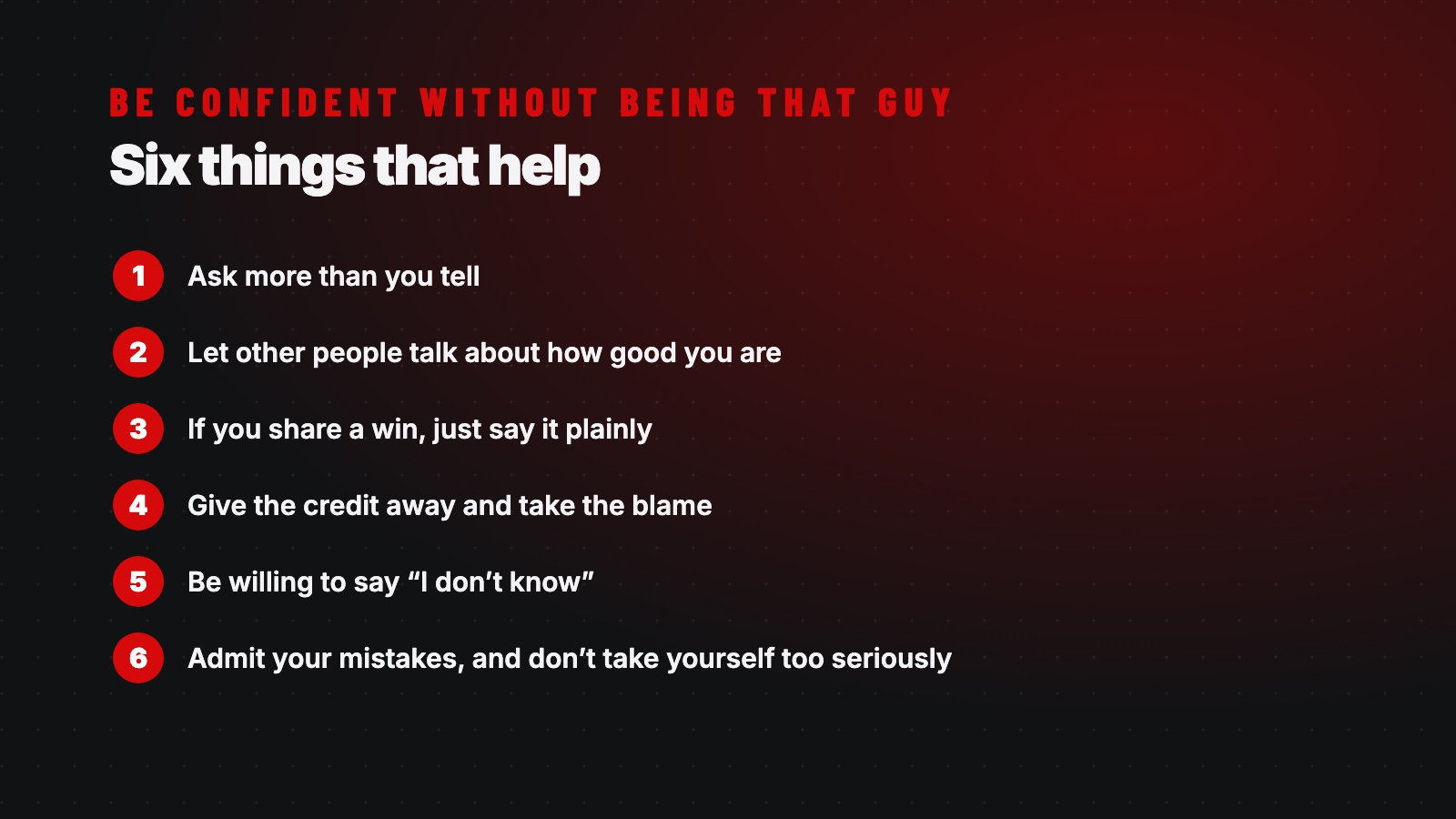
Here are six things that I think help.
1. Ask more than you tell
A team of Harvard researchers led by Karen Huang had people chat with strangers over instant messages. The people who asked more questions, especially follow up questions, were liked more. Most people did not expect that. We think we have to talk to impress people, but asking good questions does more for us.
When Jesus was twelve, his parents left Jerusalem without realizing he had stayed behind. They found him three days later in the temple, “sitting among the teachers, listening to them and asking them questions” (Luke 2:46). Luke says the people who heard him “were amazed at his understanding and his answers” (Luke 2:47). He had answers. But he was also listening and asking. If Jesus did that, we can too.
Next time you are in a conversation, count how many questions you ask compared to how many stories you tell. Which one wins?
2. Let other people talk about how good you are
Stanford professor Francis Flynn and his colleagues looked at more than 450 executives who were rated by their bosses, peers, and the people who reported to them. The most ambitious executives rated themselves higher, but the people around them did not rate them as better leaders. In another study, highly ambitious people were 4 to 10 times more likely to think their leadership skills were above average.
Joseph is a good example of this. He was in prison when he interpreted dreams for Pharaoh’s cupbearer and baker. He asked the cupbearer to mention him to Pharaoh, and then the cupbearer forgot about him for two whole years. When Pharaoh had dreams nobody could explain, the cupbearer finally spoke up and told Pharaoh about the young Hebrew in prison who had interpreted their dreams (Genesis 41:9 to 13). Then when Pharaoh told Joseph he had heard he could interpret dreams, Joseph said, “It is not in me; God will give Pharaoh a favorable answer” (Genesis 41:16). Someone else spoke up for Joseph. And once he was standing in front of Pharaoh, he gave the credit to God.
Do good work and let other people decide how good it is.
3. If you share a win, just say it plainly
Sometimes you do need to share what you have done. When you do, don’t humblebrag. I wrote about this in my last post. The research shows people like humblebraggers less and see them as less competent than people who just say what happened.
When Jesus sent out the seventy two, they came back with joy and told him what happened: “Lord, even the demons are subject to us in your name!” (Luke 10:17). They just said it. Jesus didn’t scold them for reporting it. He reminded them there was something more important to be happy about: “do not rejoice in this, that the spirits are subject to you, but rejoice that your names are written in heaven” (Luke 10:20).
If something good happened, say it simply and thank the people who helped.
4. Give the credit away and take the blame
Jim Collins studied what made good companies become great ones. The leaders of those companies had what he called personal humility combined with strong professional will. He calls it the window and the mirror. When things went well, those leaders looked out the window and gave credit to other people, and even to good luck. When things went badly, they looked in the mirror and took responsibility themselves.
Insecure leaders do the opposite. They take the credit and pass along the blame. People notice that very quickly.
John the Baptist had crowds coming out to hear him. Then Jesus started his ministry, and John’s disciples came to tell him that everyone was now going to Jesus (John 3:26). John was fine with that. He said, “He must increase, but I must decrease” (John 3:30). He was happy for the attention to go to Jesus.

5. Be willing to say “I don’t know”
Adam Grant calls this confident humility. He describes it as being “secure enough in your expertise and strengths to admit your ignorance and weaknesses.”
A lot of leaders think saying “I don’t know” makes them look weak. I think it does the opposite. It tells your team the truth, and it gives someone else the chance to bring the answer.
King Jehoshaphat did this in front of his whole nation. A huge army was coming against Judah. He stood in front of the people at the house of the LORD and prayed, “We do not know what to do, but our eyes are on you” (2 Chronicles 20:12). He was the king, and he said out loud that he didn’t know what to do. Then the Spirit of the LORD came on a Levite named Jahaziel, and he told them what God was going to do (2 Chronicles 20:14 to 17).
6. Admit your mistakes, and don’t take yourself too seriously
Bradley Owens, then at the University at Buffalo, and David Hekman studied humble leaders. The leaders they talked to said humble leaders admit their mistakes, point out the strengths of the people around them, and are open to learning. Humble leaders were more effective and better liked. A follow up study found that people who worked for humble leaders were more engaged and less likely to leave. As Owens and Hekman put it, “You can’t fake humility.”
Peter’s biggest mistake is written down in all four Gospels. He denied Jesus three times, and afterward “he went out and wept bitterly” (Luke 22:62). Jesus restored him (John 21:15 to 19), and Peter went on to be one of the leaders of the early church. Years later Paul confronted him to his face in Antioch (Galatians 2:11). And later still, Peter wrote about him as “our beloved brother Paul” (2 Peter 3:15). Peter made big mistakes, some of them in front of everyone. He kept going, and he still called the man who corrected him his beloved brother.
If you made a mistake, own it and move on. If something you did was a little funny, laugh at yourself. Everyone knows you are not perfect. Don’t pretend you are. Insecure people do that.
Where real confidence comes from
I think “that guy” is usually not as confident as he looks. If you need everyone to know how good you are, there is probably something underneath that you are trying to prove. Insecurity is where I also go back to because it is the one thing that I see so many leaders struggle with.
Look at Jesus the night before he died. John says that Jesus, “knowing that the Father had given all things into his hands, and that he had come from God and was going back to God,” got up from supper, tied a towel around his waist, and washed his disciples’ feet (John 13:3 to 5). He knew exactly who he was. He didn’t have anything to prove, so he was free to serve them.
For those of us who follow Jesus, our confidence doesn’t have to come from our résumé. It comes from knowing who we are in Christ. Tim Keller wrote a short book on this. His point was that because of Jesus, God’s verdict on us is already in. We are fully known and fully loved, so we don’t have to win every conversation to prove something. That frees us up to make the conversation about the other person. Philippians 2:3 says, “Do nothing from selfish ambition or conceit, but in humility count others more significant than yourselves.”